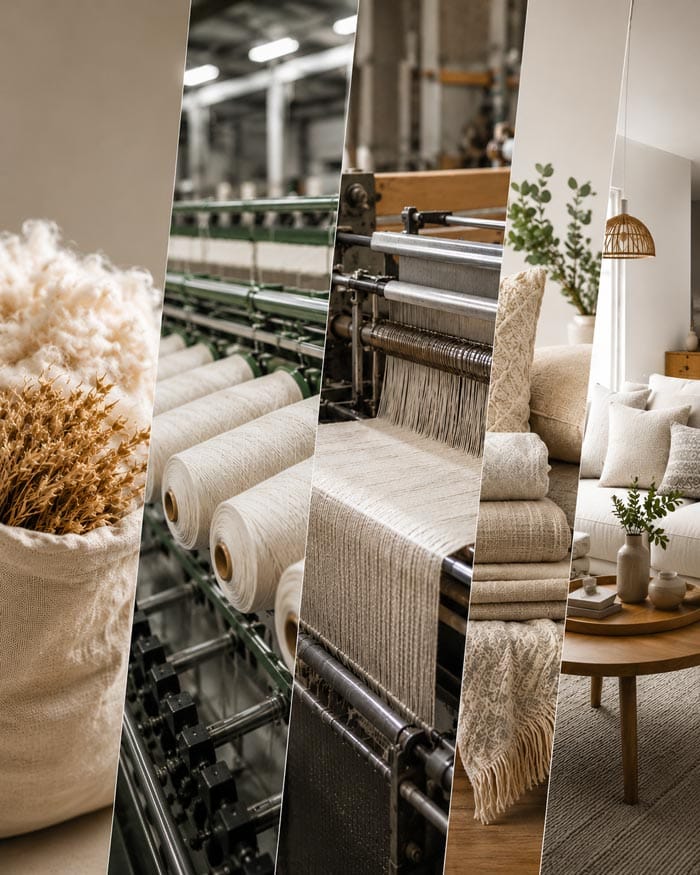
Vertical integration means a manufacturer controls each step of production in-house, from yarn to finished product. For home furnishings buyers, that control shapes cost, quality, lead times, capacity and flexibility. It also changes who you deal with. This guide explains what vertical integration involves, how to spot it, and why it matters when you choose a manufacturer.
The short answer
- A vertically integrated manufacturer runs the full chain, not just one step.
- That control means tighter quality, fewer delays and better cost discipline.
- It also gives one point of accountability, instead of a chain of vendors.
- For private label and large orders, it lowers risk as volumes grow.
What vertical integration includes
In a vertically integrated setup, one manufacturer runs each stage under its own roof:
- Yarn and raw material handling.
- Dyeing and colour matching.
- Weaving and tufting.
- Stitching and sewing.
- Filling, backing and finishing.
- Quality testing in dedicated labs.
- Packing, warehousing and dispatch.
We run all of these across three facilities and 1.2 million square feet, with a workforce of more than 900 people. Production is supported by solar power and in-house testing.
Vertical integration vs trading houses
Many suppliers are not manufacturers. They are trading houses that take your order and place it with separate factories. That adds margins and middlemen, and it splits responsibility when something goes wrong.
A vertically integrated manufacturer is different:
- The factory that quotes your order is the factory that makes it.
- Quality is controlled at each stage, not inspected at the end by a third party.
- Communication runs directly with the people who make your product.
If a supplier cannot show you the looms, tufting machines and stitching lines, you may be dealing with a trader, not a maker.
Why it matters for buyers
Consistent quality. Each stage is checked in-house, so issues are caught early. We use multi-step verification and our own labs to test yarn, colour and strength. Problems are fixed at the source, not discovered at the port.
Better cost control. Controlling each step removes middle margins. Owned infrastructure and solar power keep operating costs down. That keeps pricing competitive at the same quality.
Reliable lead times. Fewer outside dependencies mean fewer delays. Work moves between stages without waiting on external vendors. For seasonal ranges, that timing matters.
Capacity to scale. Large, in-place capacity lets a manufacturer grow with your orders. We tuft on 560-needle machines and fill 200,000 pieces per month. A first order and a repeat order ten times larger run on the same lines.
Easier customisation. In-house design and production make private label and product development simpler. Our design team works directly with buyers on construction, colour and finish.
One point of accountability. When one partner owns the full process, there is no finger-pointing between a trader and a factory. You have a single contact and a single owner of the result.
How to check a manufacturer is genuinely integrated
Ask direct questions before you commit:
- Which production steps do you run in-house, and which are outsourced?
- Can we see the looms, tufting machines and stitching lines, in person or on video?
- What is your tested capacity per category, per month?
- How do you verify quality between stages, and do you have in-house labs?
- Which certifications do you hold, and can you share the certificates?
- What lead times apply for first orders and for repeat orders?
Clear, specific answers point to a real manufacturer. Vague answers often point to a trading house.
What it means for different buyers
- Large retailers. In-place capacity reduces the risk of delays when orders grow. One owner of quality simplifies audits and compliance.
- Growing brands. A manufacturer that can scale removes the need to change suppliers as volumes rise.
- Private label buyers. In-house design and production make custom ranges faster to develop and easier to control.
Sustainability and compliance
Vertical integration also helps on sustainability. When one manufacturer controls each stage, it can prove how a product was made, not just claim it. We hold certifications across product safety, social compliance and recycled content, including OEKO-TEX Standard 100, SEDEX, SA8000, BSCI, BCI and Global Recycled Standard. That gives buyers the documentation retailers and consumers now expect.
Frequently asked questions
Is vertical integration better than using specialist vendors?
It depends on your needs. Vertical integration gives more control over quality and timelines, and it simplifies communication, because one partner owns the full process.
Does vertical integration lower cost?
It can. Removing middle margins and controlling operations helps keep pricing competitive at the same quality.
How do I know if a supplier is a manufacturer or a trading house?
Ask to see the production lines and the certificates. A real manufacturer can show you the looms, tufting machines and labs. A trading house usually cannot.
Can a vertically integrated manufacturer handle custom and private label designs?
Yes. In-house design and production make customisation and private label development easier and faster.
How does vertical integration affect lead times for large orders?
In-place capacity reduces the risk of delays when orders grow, because the manufacturer does not need to expand before it can deliver.
Work with us
We are a vertically integrated home furnishings manufacturer in Panipat, India, serving retailers in Australia, the UK, Europe and the USA. If you want to see how our setup fits your sourcing, get in touch. We will walk you through our facilities, capacity and certifications, and show you how we would make your range.