Most retailers build a home textiles range from more than one product. Rugs, cushions, throws, bath mats, poufs and storage all sit in the same part of the store, but they often come from different suppliers in different countries. Sourcing the full range from one manufacturer in India is a way to simplify that. This guide explains how the model works, where it helps, where it does not, and what to check before you move several categories to a single supplier.
The case for one supplier across categories
Every supplier you add is another relationship to manage, another quality standard to verify, another set of lead times to track and another shipment to coordinate. Sourcing several categories from one manufacturer reduces that load in a few concrete ways.
- Fewer vendors. One contract, one point of contact and one set of terms instead of five.
- Consistent standards. The same compliance, testing and quality process applies across the whole range, so a cushion is held to the same standard as a rug.
- Simpler logistics. You can consolidate categories into the same shipment, which lowers freight cost and the number of arrivals to handle.
- A coordinated look. When one design team works across categories, colours and styles match across the range rather than clashing.
- One point of accountability. When something needs to change, you are speaking to the business that made the product, not to an agent in the middle.
You can see how a full range is organised on our products page.
What a full-range home furnishings manufacturer makes
A manufacturer set up for retail ranges should cover the core soft furnishings categories in-house, rather than making one and buying in the rest. The categories that usually sit together are these.
- Rugs and carpets, often the anchor of a range, in woven, tufted and printed constructions.
- Cushions, in plain, printed, woven and embroidered styles, supplied as covers or filled.
- Bath mats, in absorbent cotton and microfibre piles with secure backings.
- Throws, woven and knitted, in seasonal weights and finishes.
- Poufs and stools, supplied filled or flat-packed to save freight.
- Storage baskets, in cotton rope, jute and braided constructions.
- Tote bags, in cotton, canvas and jute, with branding options.
Making all of these under one roof means a buyer can build a coordinated range in matching colours and styles, rather than stitching one together from separate suppliers. For rugs specifically, see our guide to rug and carpet manufacturers in India.
Manufacturer or trading house?
The same question applies here as with any single category, and it matters more when you are placing several. A trading house places your order with factories it does not own, which means your range is spread across businesses you cannot see, each with its own standard. An integrated manufacturer runs the production itself, which gives you direct control of quality, cost and timelines across every category. Ask who owns the machines, ask to see the facilities, and ask who runs the dyeing, filling and finishing. You can see how an integrated operation is set up on our infrastructure page.
When one supplier makes sense, and when it does not
Consolidation is not always the right answer, and a good supplier will tell you so. One manufacturer makes sense when the categories you want sit within its capability, when you value a coordinated range, and when you want to reduce the number of relationships you manage. It makes less sense when a category needs a specialist process the manufacturer does not run, or when you deliberately want to spread risk across more than one source. The honest position is that a full-range manufacturer should cover the heart of your soft furnishings range well, while you keep the freedom to source a specialist line elsewhere.
What to check before you consolidate
Before you move several categories to one supplier, confirm they can carry the load across all of them, not just the one they are known for.
- Certifications. Look for OEKO-TEX Standard 100, the Global Recycled Standard, ISO 9001 and ISO 14001, and social compliance through SEDEX, SA8000 or amfori BSCI.
- Capacity across categories. A supplier that makes one category well may not be set up for the others. Check the equipment and the volumes for each category you plan to place.
- Design capability. An in-house design team that understands your market keeps a multi-category range coherent and reduces revisions.
- Sampling and minimums. Confirm the minimum order per category, and that pre-production samples are made before each bulk run.
- Quality control. Ask how quality is checked across different categories, and whether there is in-house testing for each.
- Export experience. Check they already ship to your market and hold the right compliance and documentation for it.
How design and product development works across a range
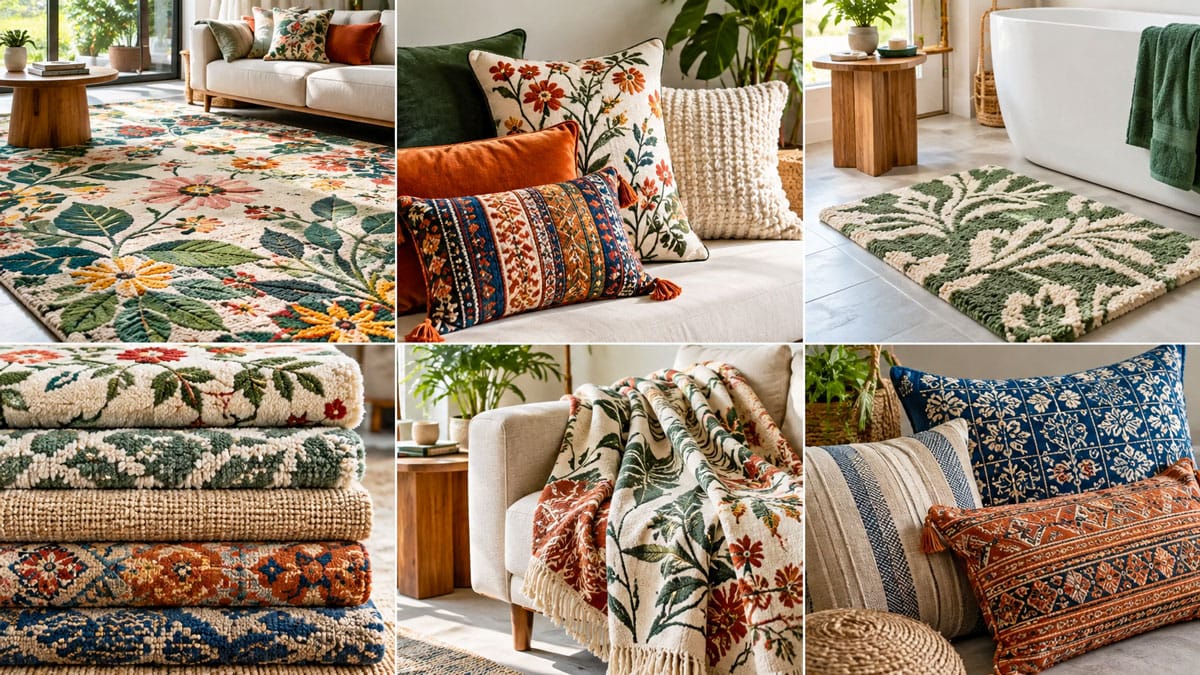
Developing a single coordinated range is different from buying one product. The strongest setups give you three routes, often used together. You can send your own designs across categories. You can brief an in-house design team to create a coordinated story, so the rug, the cushion and the throw share a palette and a feel. Or you can build from an existing catalogue. When one team develops the whole range, the colours and finishes line up, which is hard to achieve when each category comes from a different supplier.
Logistics, lead times and order planning
Sourcing a range from one manufacturer also simplifies planning. Lead times can be aligned so categories arrive together, samples can be developed in parallel, and orders can be consolidated into the same shipment. For seasonal ranges, a single supplier can plan capacity ahead with you, so the whole range is ready for a launch rather than trickling in from several sources at different times. It is worth agreeing the critical path early, including sampling, approval, production and shipping, so the range lands when you need it.
How Sheen Tex India works as a single-source manufacturer
We are a vertically integrated home furnishings manufacturer and exporter based in Panipat, India, and we have made home furnishings since 1996. We run three facilities across 1.2 million square feet with a workforce of more than 900 people, and we make all seven categories in-house. We hold 11 certifications across product safety, environment, social compliance and supply chain security, our facilities run on solar power, and our in-house design team works to the colours and styles that sell in Australia, the United Kingdom, Europe and the United States. Because we control each stage of production, we can hold the same standard across a rug, a cushion and a basket, and plan a coordinated range to a single timeline. You can read more about us, or see how an order is made on our infrastructure page.
How to start
Tell us the categories you are planning, your designs or references, your sizes and your volumes. We will recommend constructions and materials, make samples, and confirm minimums and lead times for each category, with a clear plan for how the range comes together. Get in touch to start a project.