Woven and tufted rugs are made in two different ways, and the method shapes cost, durability, design range, weight and lead time. Woven rugs are built on a loom, yarn by yarn. Tufted rugs are made by punching yarn into a backing. Both belong in a retail range. The right choice depends on your price point, the look you want, the order size and the end use. This guide explains the difference in plain terms, so retail buyers and importers can specify the right construction with confidence.
The short answer
- Woven rugs last longer and suit premium ranges and detailed patterns.
- Tufted rugs are faster to make and suit volume ranges, plush textures and quick restocks.
- Cost usually sits lower for tufted and higher for fine woven work.
- Many retail ranges carry both, woven at the top and tufted in the core.
How woven rugs are made
Woven rugs are built on a loom. Warp yarns run lengthways. Weft yarns pass across and interlock with them. The pattern is built into the structure of the rug, not added on top.
Common woven methods include:
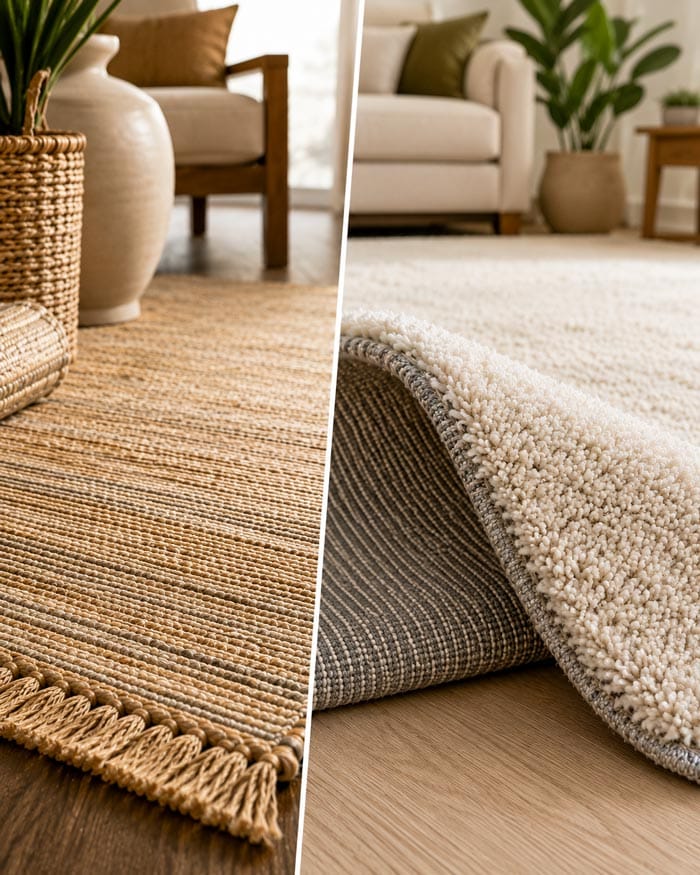
- Flatweave. No pile. Light, reversible and hard-wearing. Good for runners and layering rugs.
- Power-loom weaving. Faster woven production at scale, with consistent quality.
- Jacquard weaving. Complex multi-colour patterns built into the weave.
Woven rugs share a few traits:
- Strong and long-lasting under heavy use.
- Clean, defined patterns and crisp edges.
- Higher production time per piece for fine work.
We weave on 50 shuttle-less looms, 110 power looms with jacquard attachments and 10 jumbo jacquard machines. That mix lets us run flatweave, fine woven and large jacquard designs in one facility.
How tufted rugs are made
Tufted rugs are made by punching yarn through a fabric backing. A tufting tool pushes loops of yarn into the base cloth. A secondary backing and a latex coating then lock the tufts in place. The surface can stay as loops or be sheared into a cut pile.
Two main approaches exist:
- Hand-tufted. A handheld tufting gun gives more control for custom designs and texture.
- Machine-tufted. Wide machines produce large volumes at speed and consistent quality.
Tufted rugs share a few traits:
- Faster to produce, which suits large orders and quick restocks.
- A wide design and texture range, including cut pile, loop pile and carved effects.
- Soft, plush surfaces that work well in bedrooms and living spaces.
We tuft on 2.15 metre wide machines with 560 needles, plus 300 tabletop tufting machines and high-speed machines. This covers both broad volume runs and detailed hand-tufted work.
Woven vs tufted, side by side
A quick comparison for buyers:
- Durability. Woven usually lasts longer under heavy foot traffic. A dense tufted rug with a strong backing also performs well.
- Cost. Tufted is often more cost-effective. Fine woven and jacquard work sits higher.
- Lead time. Tufted is faster for large volumes. Fine woven takes more time per piece.
- Design range. Tufted offers more texture and pile effects. Woven offers crisp, structural patterns.
- Weight and feel. Woven tends to be flatter and firmer. Tufted tends to be softer and plusher.
- Reversibility. Many flatwoven rugs are reversible. Tufted rugs are not.
Which construction fits your range
Match the construction to the role of the product:
- Premium and statement ranges. Choose woven for durability claims, fine patterns and a structured look.
- Core and volume ranges. Choose tufted for soft textures, broad design variety and fast restocks.
- Runners and layering rugs. Flatweave suits these well.
- Bedroom and lounge ranges. Plush tufted piles work well here.
Most retail ranges use a mix. A common approach is woven at the top of the range and tufted through the core, which balances margin, design and price points.
Materials and yarns
The yarn matters as much as the construction. Common options:
- Wool. Soft, durable and naturally flame resistant. A premium choice.
- Cotton. Soft and washable. Common in flatweave and lighter rugs.
- Polypropylene. Stain resistant and cost-effective. Common in volume ranges.
- Polyester. Soft, with strong colour clarity.
- Viscose. A silky sheen for accent rugs.
- Jute and natural fibres. Textured, natural looks for flatweave.
We help buyers match yarn, construction and price point so the finished rug fits the range it is built for.
What to specify when you order
Clear specifications reduce sampling rounds and protect quality. Share:
- Pile height and pile weight (GSM).
- Backing type and anti-slip requirements.
- Colour fastness, shrinkage and shedding standards.
- Exact sizes and size tolerances.
- Packing, labelling and barcode requirements.
- Certifications you need. We hold OEKO-TEX Standard 100, BSCI, SEDEX, SA8000, BCI, Global Recycled Standard and more.
Quality checks worth running
Good buyers verify quality at three points:
- Pre-production samples. Approve construction, colour and size before the run.
- In-line checks. Confirm consistency during production.
- Final inspection. Use an agreed AQL standard before shipping.
We run multi-step verification in-house, with our own labs for yarn, colour and strength. That keeps quality consistent across large orders.
Minimum orders and lead times
Minimums and timelines depend on construction, design and yarn. Fine woven work and custom designs usually carry higher minimums than core tufted ranges. Share your designs and volumes and we will confirm what works for each item.
Sustainability and compliance
Retail buyers increasingly need proof, not claims. Recycled yarns, responsible cotton and audited factories all matter. Our certifications cover product safety, social compliance and recycled content, so your sourcing stands up to retailer and consumer scrutiny.
Frequently asked questions
Are tufted rugs lower quality than woven rugs?
Not necessarily. Tufted rugs can be high quality. Woven rugs tend to last longer under heavy use, while tufted rugs offer more texture and faster production.
Which construction is better for high foot traffic?
Woven constructions usually handle heavy foot traffic best. A dense tufted rug with a strong backing also performs well in most retail settings.
What is the difference between hand-tufted and machine-tufted rugs?
Hand-tufted rugs are made with a handheld tufting gun, which suits custom designs and texture. Machine-tufted rugs are made on wide machines, which suits large volumes at consistent quality.
Can one manufacturer make both woven and tufted rugs at retail scale?
Yes. We run woven and tufted lines under one roof, which keeps quality and timelines consistent across a mixed range.
What is the minimum order for private label rugs?
It depends on construction, design and yarn. Share your range and volumes and we will confirm what works.
Which rugs are easiest to keep clean?
Flatweave and tight loop-pile rugs are usually easiest to clean. Stain-resistant yarns such as polypropylene also help.
Work with us
We make woven and tufted rugs for retailers across Australia, the UK, Europe and the USA. If you are planning a rug range, share your designs, sizes and volumes. We will map the right construction, yarn and price point for each piece, and produce them at retail scale.