For most of the past two decades, sourcing home furnishings from China was the default. The volume was there. The infrastructure was there. The pricing worked. And the supply chain, while never simple, was at least well understood.
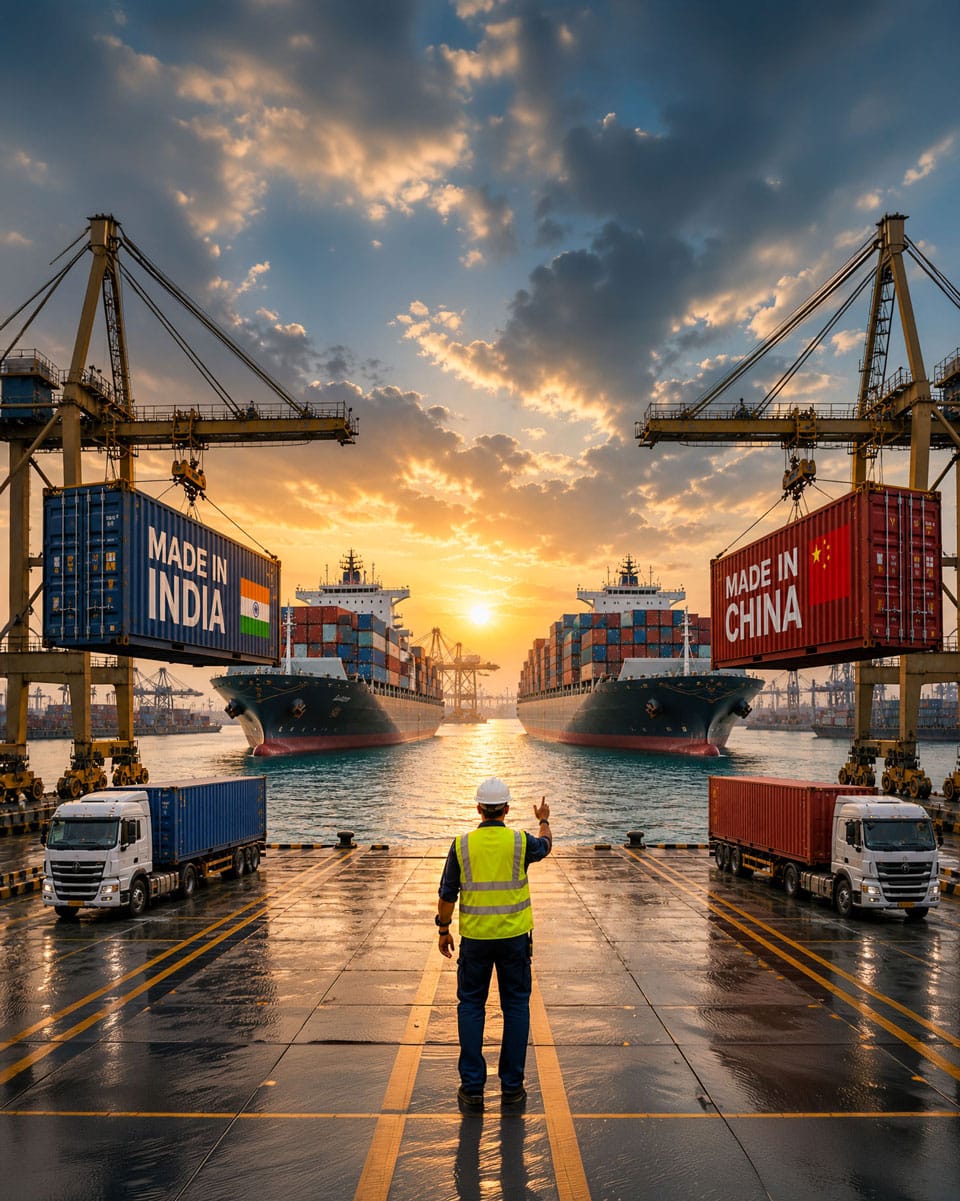
That default is being reconsidered. Not abandoned overnight, but meaningfully questioned in buying offices across Australia, the UK, Europe, and the United States. The reasons are a combination of tariff pressure, compliance scrutiny, supply chain risk, and a growing realisation that India, and in particular Panipat, has matured into a credible alternative that did not exist at this scale ten years ago.
This article is not a case for switching entirely. It is a straight look at what has changed, where India genuinely competes, and where China still holds ground. Procurement managers making sourcing decisions in 2026 deserve a clear view of both.
What Has Actually Changed
The Tariff Environment Is Not Going Back to Normal
The US-China tariff escalation that began in 2018 never fully unwound. By 2025, Chinese home textiles and soft furnishings faced cumulative tariff rates that made the landed cost calculus fundamentally different from what it was five years ago. For US buyers, sourcing Chinese-origin goods meant absorbing tariffs that in many categories pushed total duty rates well beyond 25%, with some categories reaching significantly higher.
India, by contrast, faces no Section 301 tariffs in the United States. For buyers supplying the US market, this alone creates a meaningful cost differential on comparable products.
In Australia, India’s position improved further with the full implementation of the Economic Cooperation and Trade Agreement (ECTA), which granted Indian textiles zero-duty access to the Australian market. Indian home textile exports to Australia grew 14.2% in 2025 as a direct result. Australia’s home textile import market is valued at over $2 billion, with China still holding the majority share, but Indian suppliers gaining ground with every buying cycle.
China Plus One Is Now Mainstream Procurement Policy
The phrase “China Plus One” entered procurement conversations around 2013. By 2026, it is no longer a strategy discussed in risk workshops. It is operational reality for most mid-to-large importers sourcing home furnishings. Global retailers including Gap, H&M, Zara, and Uniqlo have been placing more orders with Indian manufacturers as part of deliberate supply chain diversification.
The underlying logic is not complicated. Concentrating the majority of your supply base in a single country, particularly one with an unpredictable trade policy relationship with your primary market, is a risk that boards and CFOs are no longer willing to underwrite. Diversifying does not mean abandoning China. It means building a parallel supply relationship in at least one other geography.
For home furnishings specifically, India is the most natural destination for that parallel relationship.
India’s Output Has Grown Substantially
India’s textile exports grew by 14% in 2024, while China’s textile export growth slowed to under 2% annually from 2022 onwards. The Indian home textile market reached USD 10.38 billion in 2025 and is projected to grow at a compound annual rate of over 8% through 2030.
This is not just volume growth. It reflects investment in manufacturing capacity, design capability, and the compliance infrastructure that global retailers require. The manufacturers who have grown into this moment are not the cottage industries of a generation ago. They are large-scale, vertically integrated operations with modern equipment, in-house QC, and the certifications that European, UK, and Australian buyers expect as a minimum condition of trading.
Where India Genuinely Competes with China
Cost
For cotton-dominant product categories, including woven throws, cushion covers, and bed linen, India offers 15 to 25% cost savings compared to China on equivalent specifications. This advantage is structural, driven by access to domestic cotton supply, competitive labour costs, and for the better manufacturers, operational efficiencies like solar-powered production that reduce overhead.
When US tariffs on Chinese goods are factored in, the landed cost differential widens further. A buyer sourcing woven throws from India for the US market is comparing a product with no additional duty against one carrying a tariff that can exceed 25%. That changes the conversation.
Certifications and Compliance
The assumption that Chinese manufacturers lead on compliance and certification is outdated in the home furnishings category. Established Indian manufacturers, particularly those in Panipat, hold the full range of certifications that global retailers require: OEKO-TEX Standard 100, amfori, SEDEX, GRS, SA8000, ISO 9001:2015, and ISO 14001:2015, among others. These are the same standards required by Marks and Spencer, IKEA, Target, and the major supermarket own-label programmes.
For buyers operating in the EU, UK, and Australia, where supply chain due diligence requirements are tightening under new regulations, the ability to demonstrate a fully audited, certified supply chain is increasingly a condition of doing business, not just a procurement preference. Indian manufacturers at the top end of the market meet this requirement without difficulty.
Sustainability Credentials
India has a structural advantage in sustainable home textiles. Cotton is the dominant raw material, domestic supply is abundant, and a growing number of manufacturers have invested in solar-powered operations, recycled content capabilities, and GRS certification. For buyers whose retail programmes require a sustainability story, India can provide it with greater ease than China across most home textile categories.
Design and Private Label Capability
The manufacturing-only model, where an Indian factory produces to a foreign buyer’s specification with no design input of its own, is not the only model available in 2026. A number of established manufacturers in Panipat have in-house design teams with market specialists covering the US, European, and Australian retail environments. They can co-develop a seasonal range, not just produce one.
Where China Still Holds Ground
An honest comparison requires acknowledging where China remains ahead.
Speed and Volume at the Extreme End
For categories requiring very short lead times or extremely high-volume production runs with tight tolerances, China’s manufacturing infrastructure is still more developed. The logistics ecosystem around Chinese factories, particularly in the Pearl River Delta and Yangtze Delta manufacturing zones, is more efficient for rapid turnaround.
Synthetic and Technical Textiles
China’s dominance in synthetic fibre production gives its manufacturers a cost advantage on polyester-dominant products and technical textiles. For buyers sourcing primarily in these categories, the cost equation does not shift as dramatically in India’s favour as it does for cotton and natural fibre products.
Established Relationships
Buyers who have sourced from China for ten or fifteen years have relationships, processes, and institutional knowledge built around that supply chain. Switching requires investment: factory visits, sampling rounds, QC system alignment, and a period of relationship building. This is not a reason to avoid the shift, but it is a real cost that should be factored into any sourcing decision.
What the Smartest Buyers Are Actually Doing
The buyers who are navigating this most effectively are not making binary choices. They are not wholesale switching from China to India or dismissing India because China still works for certain lines.
The pattern that is working is category-level diversification. Cotton and natural fibre categories, including woven throws, knitted throws, cushion covers, and bed linen, are being shifted or dual-sourced from India. Synthetic and technical categories are retained from China where the cost and speed advantages hold.
This gives buyers a more resilient supply base, a more defensible compliance position, and a credible sustainability narrative, without the operational disruption of wholesale change.
What to Do Next If You Are Evaluating India
If you are at the stage of evaluating Indian manufacturers seriously, the practical steps are straightforward.
Start with a factory visit. The difference between manufacturers in Panipat is significant. A visit tells you in two hours what six months of email cannot. Look at the production floor, the QC process, the certifications, and whether the team understands your market’s specific requirements.
Run a parallel development. Place a development sample order with an Indian manufacturer on a line you currently source from China. Compare quality, lead time, and cost on an equivalent specification. The comparison will tell you more than any analysis will.
Build the relationship before you need it. The buyers who found their Indian sourcing relationships most useful during the supply chain disruptions of the last few years were the ones who had built those relationships before a crisis forced them to.
We have been manufacturing and exporting home furnishings from Panipat since 1996. We work with buyers in Australia, the UK, Europe, and the United States across rugs & carpets, bathmats, cushions & throws, poufs & stools, storage baskets, and tote bags. If you are evaluating India as part of your sourcing strategy and want to see what we make and how we work, reach out at sheentexindia.com.