India is one of the largest sources of rugs and carpets in the world, and most of that production runs through Panipat in the northern state of Haryana. For a retail buyer, that scale is both an advantage and a challenge. The choice of supplier is wide, the quality varies from one factory to the next, and the word manufacturer is used loosely by businesses that do not actually make anything. This guide explains how to source rugs and carpets from India, how to separate a real manufacturer from a middleman, and what to check before you place an order.
Why retailers source rugs from India
India combines a long weaving and tufting tradition with the capacity to produce at retail volumes. Panipat in particular has grown into a dense cluster of mills, dyeing units, yarn suppliers and finishing houses, so a single region can take a rug from raw fibre to a packed, export-ready product. That ecosystem is the reason buyers can find almost the entire construction range in one place.
The material range is broad. Indian manufacturers work in wool, cotton, polyester, polypropylene, viscose, jute and recycled yarns, which lets you cover both entry price points and premium styles from the same source. The cost base is competitive, and the export infrastructure, from documentation to freight forwarding, is well established. For most retail ranges, India can supply the volume lines and the standout pieces together. You can see the kind of range this involves on our rugs and carpets page.
The types of rugs you can source
Rugs are not a single product, and the construction you choose affects price, durability, lead time and the look of the finished range. The main types you will come across are these.
- Woven rugs. Made on a loom, one yarn at a time. They are hard-wearing and hold detailed patterns well. Flatweaves and dhurries sit here, along with finer woven constructions.
- Hand-tufted rugs. Made by punching yarn into a backing by hand, then finishing with a secondary backing. They allow deep pile and rich texture at a lower cost than hand-knotted work.
- Machine-tufted rugs. Made on tufting machines for higher volumes and consistent quality, well suited to core retail ranges.
- Printed rugs. A base cloth printed with a design, useful for fashion-led ranges and lower price points.
A capable manufacturer makes more than one of these, so a single range can carry fine woven styles at the top, tufted styles in the middle and printed styles at the entry level, all from one supplier and with one point of accountability.
Manufacturer or trading house?
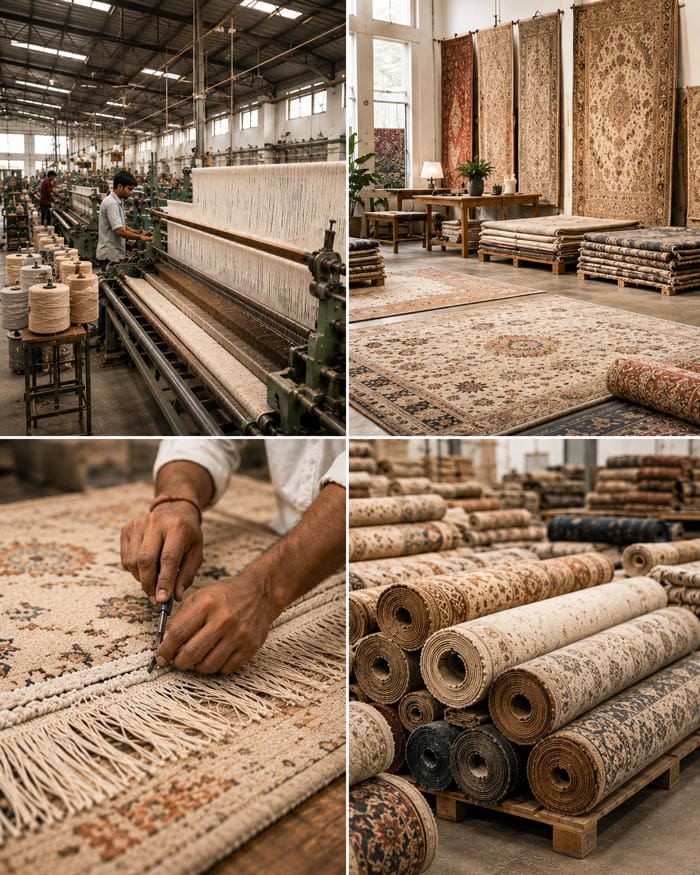
This is the first thing to establish, because it changes everything that follows. A trading house takes your order and places it with mills it does not own. An integrated manufacturer runs the production itself, from yarn and dyeing through weaving or tufting to finishing and packing.
The difference matters in four ways. Quality, because a manufacturer controls each stage and can fix a problem at its source rather than passing it down a chain. Cost, because you are not paying a margin to a layer that sits between you and the factory. Design, because your artwork and specifications stay inside one business rather than being shared with third parties. And communication, because the people who quote your order are the people who make it, so answers are direct.
The test is simple. Ask who owns the looms and tufting machines, ask to visit the facility or see it on video, and ask who runs the dyeing and finishing. A manufacturer can answer all three without hesitation. You can see how an integrated operation is structured on our infrastructure page.
What to check before you commit
Once you know you are dealing with a manufacturer, work through a checklist before you place a first order.
- Certifications. For rugs, expect OEKO-TEX Standard 100 for product safety, the Global Recycled Standard for recycled content, and social compliance through SEDEX, SA8000 or amfori BSCI. Ask to see current certificates, not expired ones.
- Construction range. Confirm they make the constructions your range needs, rather than one type they then sub-contract for the rest.
- Design capability. Check whether they only copy what you send, or whether they have an in-house design team that can create for your market.
- Sampling. A serious supplier makes pre-production samples so you approve construction, colour and size before the bulk run.
- Minimum order quantity. Ask for the minimum per construction, since fine woven work usually carries a higher minimum than tufted or printed.
- Capacity and repeat orders. Confirm there is room to scale from a first order to repeat programmes without a drop in quality or a long wait.
- Quality control. Ask how they check quality, whether they have in-house testing, and whether they inspect every order before it ships.
- Export experience. Confirm they already ship to your market and handle the documentation and compliance it needs.
How design works
Good rug suppliers give you three ways to develop a range, and the best buyers use a mix of all three. You can send your own designs and have them matched and produced. You can brief an in-house design team and have them create original designs for your market, which is useful when you want something new rather than a copy. Or you can select from an existing catalogue, which is the fastest route to market. A design team that understands the colours and styles that sell in your region will save you rounds of revisions, so it is worth asking where the team is based and which markets it works to.
Minimum order quantities, lead times and pricing
Three numbers shape most sourcing decisions, and they are linked. Minimum order quantity depends on the construction, the design and the yarn, so a simple tufted range carries a lower minimum than a fine woven or fully custom design. Lead times depend on the construction, the order size and whether the design is new or a repeat, with tufted and printed ranges usually faster than fine woven work. Pricing follows the material, the construction, the size and the complexity of the design. A manufacturer should be able to explain how each of these affects your quote, rather than giving a single figure with no breakdown.
How to verify quality
Quality is easy to claim and harder to prove, so ask for specifics. A strong manufacturer checks quality at every stage in-house and uses its own labs to test yarn, colour fastness and strength. It approves samples before production, and it inspects orders before they ship rather than after a complaint. If a supplier cannot describe its quality process in plain terms, treat that as a warning.
Common mistakes to avoid
A few mistakes come up again and again. Choosing on price alone, then paying for it in returns and reworks. Skipping the pre-production sample to save a week, then receiving a bulk order that does not match expectations. Assuming a low minimum means low quality, or that a high minimum means the opposite. And treating certifications as a tick-box rather than checking they are current and cover the right areas. Avoiding these comes down to doing the checks above before the first order, not after.
How Sheen Tex India approaches rug manufacturing
We are a vertically integrated rug and carpet manufacturer based in Panipat, and we have made home furnishings since 1996. We weave on 50 shuttle-less looms and 110 power looms, and tuft on wide 560-needle machines, with the capacity to scale from a first order to large repeat programmes. We hold 11 certifications across product safety, environment, social compliance and supply chain security, and our facilities run on solar power. Our in-house design team works to the colours and styles that sell in Australia, the United Kingdom, Europe and the United States, so the designs suit buyers in your region. Because we run every stage in-house, from yarn to the finished, packed rug, problems are caught and fixed at the source. You can read more about us, or see the full product range on our products page.
If your range goes beyond rugs, the same questions apply across categories. See our guide to sourcing a full home furnishings range from one supplier.
How to start
Send us your own designs, the catalogue styles you like, or a brief for our design team, along with your sizes and target volumes. We will recommend the right construction and materials, make samples and share a quote with a clear breakdown. Get in touch to start a project.